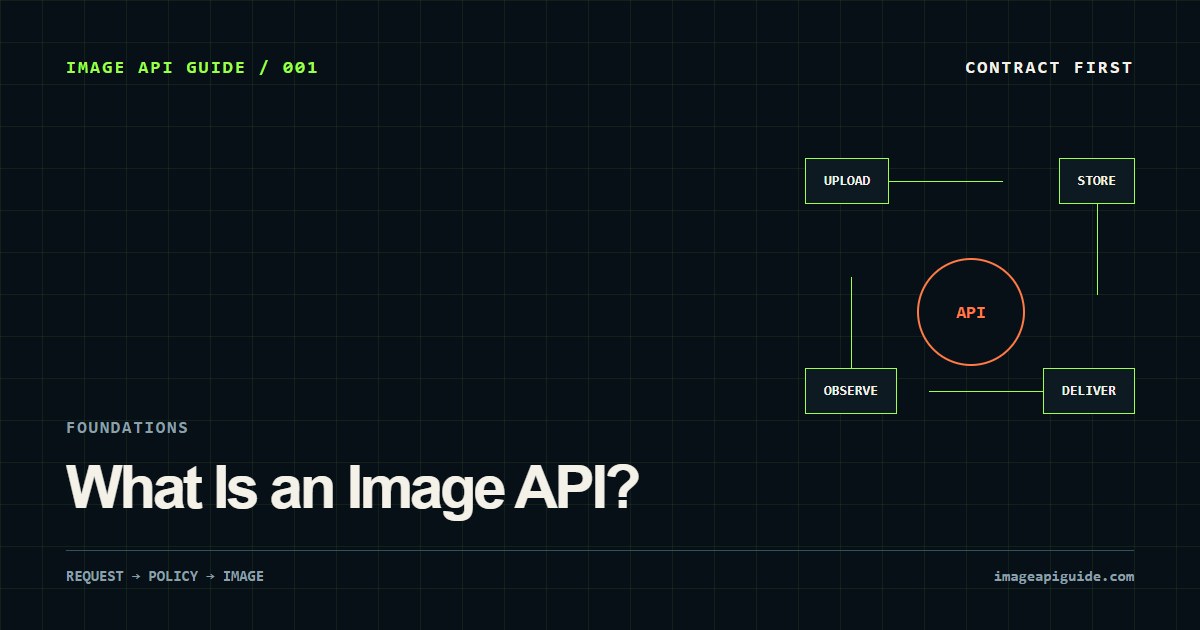
Short answer: An image API is a programmable interface for accepting, identifying, transforming, and delivering images. A useful image API hides encoder and storage details behind a stable contract while still giving developers control over security, output geometry, format, quality, caching, and failure handling.
The important word is contract. An SDK can make requests convenient, and a CDN can make responses fast, but the API contract determines what your application can ask for, what it can trust, and what happens when the request fails.
The four jobs of an image API
Most production image systems expose four related capabilities.
- Ingest: accept a local file, browser upload, stream, or allowlisted remote source.
- Manage: assign a durable identifier and store metadata, access rules, versions, and lifecycle state.
- Transform: derive a requested size, crop, format, quality level, overlay, or analysis result.
- Deliver: return the result through a stable, cacheable URL with appropriate HTTP headers.
Some products separate those capabilities into several APIs. Others combine management endpoints with transformation instructions encoded in delivery URLs. Cloudinary, for example, documents a delivery URL containing the asset type, delivery type, transformation components, version, and public identifier. Its first request can create a derivative that later requests receive from cache. That is one implementation of the broader contract, not the definition of an image API itself. See the Cloudinary transformation URL structure.
Start with the resource model
Before choosing an SDK, decide what your application considers an image resource.
A durable model usually separates:
- the original, which is the accepted source and should not change silently;
- the asset record, which holds the stable ID, dimensions, format, checksums, ownership, and lifecycle state;
- a transformation recipe, which describes the intended output;
- a derivative, which is the concrete result of applying a recipe to a particular version of the original;
- a delivery URL, which identifies a cacheable representation.
This separation prevents a common failure: treating one mutable URL as the source file, the recipe, and the public result. When those concepts are collapsed, replacing an original can make cached outputs disagree, rollback becomes uncertain, and it is difficult to explain which settings produced an image.
Use stable asset identifiers, explicit source versions, and normalized recipes. If a source changes, create a new version or produce a URL that changes predictably. The browser and CDN should not have to guess whether the bytes behind an immutable-looking URL were replaced.
The API contract matters more than the SDK
An SDK is valuable when it handles signing, multipart requests, response verification, and URL construction. Cloudinary’s upload documentation notes that its backend SDKs wrap the upload endpoint and take care of signature generation and response verification. It also documents the underlying REST upload endpoint for stacks without a supported SDK. See Cloudinary’s upload options.
Still, design against the HTTP behavior you rely on:
- Which operations are safe to retry?
- Is an upload idempotent when the connection closes before a response arrives?
- Are rate limits exposed with a useful response and delay hint?
- Can the client distinguish validation errors from temporary processing failures?
- Does a transformation request identify a stable output?
- Which fields are guaranteed across SDK versions?
The HTTP semantics specification distinguishes idempotent methods because a client can repeat them after a communication failure without changing their intended effect. An upload is often a POST, so do not assume automatic retries are safe. Add an application operation key, deterministic asset ID, or documented provider mechanism that lets the server recognize the same logical request.
Our guide to image API error handling turns that contract into a retry and telemetry policy.
Uploads define a trust boundary
An image upload is untrusted input, even when the user is authenticated. Validate more than a filename extension. Enforce allowed types, decoded dimensions, pixel-count limits, file-size limits, and ownership rules. Decide whether SVG, animated formats, layered formats, or remote fetches are allowed at all.
For direct browser uploads, keep long-lived secrets on the server. A common pattern is:
- the authenticated client asks your backend for a short-lived authorization;
- the backend checks the user and intended parameters;
- the client uploads directly to the image service;
- the application stores the verified asset response;
- a signed webhook or follow-up API call confirms asynchronous work.
Cloudinary explicitly warns not to expose its API secret in client-side code and documents signed uploads whose signature is generated on the backend. Our secure direct upload guide explains the boundary and failure cases.
Transformations should be constrained recipes
Dynamic transformations are useful because an application can request the output a layout needs. They also create a large, potentially expensive input surface.
Avoid passing arbitrary user-controlled width, height, quality, overlay, or remote-source values directly into a transformation URL. Define a small vocabulary of approved recipes or validate each parameter against strict ranges. Normalize equivalent requests so they produce the same cache key.
A practical recipe might specify:
purpose: product-card
geometry: 640 × 640
crop: fill
gravity: product-focal-point
format: automatic at delivery
quality: automatic within approved policy
version: recipe-3
The delivery URL or SDK call can encode that recipe, but the application-level name remains stable and reviewable. Our guide to image transformation URLs covers ordering, format negotiation, versioning, and cache behavior.
Delivery is an HTML and HTTP problem too
An image API cannot choose the correct rendered width if the page gives the browser no useful layout information. The MDN responsive images guide explains how srcset supplies candidates while sizes describes the image slot. The browser combines those hints with viewport and device conditions to select a candidate.
That means a complete integration includes:
- useful output widths based on actual layout slots;
- correct
srcsetandsizesmarkup; - intrinsic width and height to reserve layout space;
- early discovery for likely LCP images;
- lazy loading only for images that begin outside the viewport;
- stable cache keys and appropriate caching headers;
- a visible fallback for unavailable derivatives.
Do not judge the integration only by whether an image appears. Inspect which candidate was transferred, its encoded size, response headers, rendered dimensions, and visual quality.
A production evaluation checklist
Evaluate an image API against the complete operating path:
Contract
- Are resources, versions, jobs, and errors clearly modeled?
- Are request limits and supported formats documented?
- Can you use HTTP directly when the SDK is not a fit?
Security
- Can uploads and delivery be signed with short-lived authorization?
- Can transformations be allowlisted or constrained?
- Are webhook signatures and replay windows documented?
Transformation
- Can you control resize mode, crop, gravity, format, quality, metadata, and color behavior?
- Are named or versioned recipes available?
- Can you prevent unbounded derivative creation?
Delivery
- Are derivatives cacheable and globally deliverable?
- Can the service negotiate modern formats while preserving required fallbacks?
- Can you generate responsive candidates without inventing hundreds of widths?
Operations
- Are rate limits and retry behavior clear?
- Can requests be traced from application action to provider response?
- Can you audit assets, derivatives, usage, failures, and cost?
- Is migration possible without replacing every application concept at once?
The durable mental model
Think of an image API as a policy boundary between product code and media infrastructure.
Your application states the asset and intended use. The API authenticates the request, applies a constrained recipe, produces or locates a versioned derivative, and returns a representation the browser can cache and render. Telemetry connects the user action to the upload, transformation, delivery, and any failure.
That model survives a change of SDK, provider, framework, or image format. It also gives a team a concrete standard for deciding whether an integration is merely convenient or genuinely ready for production.